McQueen Slough – Near Dawson Creek, BC
March 17, 2026 By: Daphnee Cairns
Location: 55.793193, -120.153173
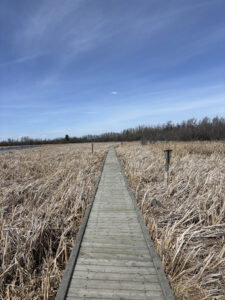
When I walk along the boardwalk at McQueen Slough near my home in Dawson Creek, British Columbia, it feels like I’ve stepped out of the city and into something much quieter and natural. Just a few minutes from town, the noise disappears, and all that is left is the sound of wind moving through the grasses and the calls of the birds. At first glance, it feels like a natural, untouched space, but upon closer inspection, it becomes clear that this landscape has a long, complex environmental history shaped by both natural processes and human activity.
Before European settlement, this region was part of the traditional territory of Indigenous peoples, including the Dane-zaa (Beaver) Nation. Like many areas in northeastern British Columbia, the land around Dawson Creek was not untouched, empty wilderness, but a landscape shaped by generations of Indigenous use. Wetlands like the McQueen Slough would have been important ecological spaces, supporting waterfowl, fish, and plant species used for food and materials. Indigenous land use is guided by knowledge of local ecosystems, and while the environmental impact of Indigenous communities on these places was less obvious than that of European settlers, their history and land use remain significant.
Things began to change more quickly with the arrival of European settlers in the early 1900s. Dawson Creekgrew as a farming and transportation center, especially with the development of the railway and the Alaska Highway during World War II. These changes brought settlement to the region and major environmental impacts. Wetlands like McQueen Slough were often seen as land that needed to be drained or controlled to make way for farming and other developments.
Even though the slough still exists today, it has likely changed over time. One clear example of this is the small weir that helps control water levels. This shows how people have tried to manage the natural flow of water. Instead of letting the wetland fully follow its natural cycles, the water is carefully managed. This is a good example of how humans don’t just live in environments, they actively try to shape and control them. Another example is the proximity of agricultural fields. Almost immediately adjacent to the slough are hay fields, grazing lands, and canola fields; all signs of encroachment on this natural space, possibly as the water in the slough could have been useful for irrigation purposes. It would be interesting to fully understand the impact of neighbouring agricultural uses on the slough. Does it change which birds and waterfowl frequent the slough? Are the grasses along the boardwalk all native species, or did new plant species get introduced due to the proximity to crops? How has nearby land clearing impacted water flows and soil conditions?
The slough, actively maintained through a partnership between Ducks Unlimited, the local conservation club, and the Provincial government, plays an important ecological role in the region today. It provides an essential habitat for a number of birds and waterfowl that need protected spaces like this for feeding, nesting, and migration. It provides an essential refuge for wildlife in a region that has seen drastic changes due to human settlement, agriculture, and industrial activity.
While the slough provides a space for wildlife to peacefully coexist, there are also clear signs that people remain an active and influential presence there today. The boardwalk highlights human access and use while also protecting the delicate grass and wetlands below from damage. Another prominent sign of human impact is the shotgun shells littered across the site, which show the area’s connection to waterfowl hunting and highlight that our protection of this space is not altruistic.
While wild at first glance, the slough is a place of recreation, substance hunting, and flood mitigation for humans. Its ecological history has been shaped by people for generations and continues to be shaped today. What stands out most is how this space reflects a balance between natural processes and human control. The presence of the boardwalk and the weir, along with the neighbouring agricultural land, indicates that this is not a completely natural system. Instead, it is a managed landscape where humans decide the fate of the ecosystem. However, like most natural spaces, humans cannot control everything. The birds, the seasonal changes in water levels, and the growth of plants are all beyond human control and share in the responsibility to shape the land.