Vancouver, BC, Canada
February 18, 2026 By: T00736087
Location: 5878 Beatrice Street, Vancouver, BC V5P 3P9, Canada
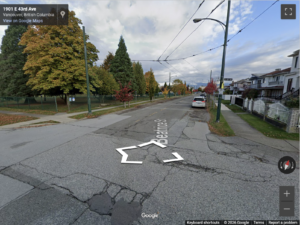
Currently, the street that we live on looks like a peaceful, suburban street. At first glance, it appears to be rather normal and would seem to be a very metropolitan area. However, upon further reflection and consideration of its environmental past, I realized and learned a lot about that this area has had a number of significant changes and that what we see today is just the new layer of transformation.
This part of South Vancouver was part of a coastal rainforest that connected to the Fraser River Delta which is why this area would have been much wetter than it is today, and there would have been a lot of small creeks, lots of dense tree cover, and fertile soil which we know is good for animal and plant life. So when I reflect on the relative flatness of my neighbourhood, it has more personal significance, it is not simply a good or convenient location to build houses, but it is also a reminder that this was once a floodplain formed by water.
The wildlife that once lived here would have been very different from what exists now. Prior to urbanization, raccoons would rummage through trash and coyotes would occasionally trot through cities but now deer, beavers, salmon run, and various types of birds call this area home. Our environment has adapted to survive alongside humans rather than be destroyed by the loss of trees or natural ecosystems as a result of urbanizing. 1
The arrival of the Europeans significantly changed the environment. They began cutting down trees for timber and clearing land to farm. In addition to the change in vegetation layers in this area as a result of urbanization I find it interesting that before it became the residential area we know today, it was actually agricultural land. The land was very fertile because of the deposits left behind by the rivers, and as a result, early settlers used it for farming. The relationship between natural geography and human land use is just something I never paid attention to until I began studying the history of our environment. 2
As Vancouver grew in the 20th Century farmland became divided into parcels and residential developments appeared, including Beatrice St. Water that used to flow naturally across land now drains into storm sewers, which is great for convenience as our lives are made easier when there isn’t mud or standing water every time it rains; however, it also conceals the natural systems that originally existed in this area. 3
This statement was made by an urban resident who stated that “it is still easy for me to see the evidence of ‘nature’ in what is now an urban setting like mine.” The majority of urban homes are designed with small gardens and there are many street trees planted within the sidewalks and in small parks which create an abundance of “greenery”. They have all created a considerable amount of green space throughout the area and show that some attempt is being made to reclaim the neighborhoods back to its original natural state.
The existence of invasive plant species serves as a part of the storytelling within the environment, particularly the non-native Himalayan blackberry. Once I became interested in learning more about the invasive plant species growing in ‘wild’ areas, these plants quickly became a part of my overall understanding of how humans settled their land. They are evidence of how the world-wide movement of plants combined with the movement of people changed the ecology of this area. 4
Everyone in charge of caring for the environment gives me a lot of hope. I think of support from city programs like tree planting, urban farms, and other examples. Growing efforts like these to help repair some of the damage done by prior developments lead me to think about a neighborhood as a place built to last, and being currently improved. I get particularly excited about the fact that Vancouver has such a huge ambition of becoming the “greenest city” as an indication of a very different set of values associated with how we live more about living in partnership with than in control of. 5
By studying the environmental history of this address, I look at this place differently now; it is more than just a place that people live. This location has been a wetland, a cut-over area, agricultural land, and now is a housing pod that has become more sustainable. Acknowledging this has helped me realize that every ordinary location has a connected, lengthy, and influential environmental history and that urban areas are simply a part of nature and not separate from or in conflict with nature.
1 Stanley Park Ecology Society, Urban Wildlife in Vancouver, https://stanleyparkecology.ca.
2 Vancouver Heritage Foundation, South Vancouver Settlement History, https://www.vancouverheritagefoundation.org.
3 City of Vancouver, Rainwater Management and Sewer History, https://vancouver.ca.
4 Invasive Species Council of British Columbia, Invasive Plants of the Lower Mainland, https://bcinvasives.ca.
5 City of Vancouver, Greenest City Action Plan, https://vancouver.ca.