Chilliwack Environmental History
September 29, 2026 By: Allison Jakeway
Location: 9330 Corbould St, Chilliwack
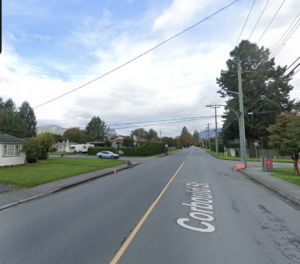
Local Environmental History of Chilliwack
A few weeks ago I moved to the downtown area of Chilliwack, B.C. In the time since, I have enjoyed exploring the area by walking along the Hope River Slough which runs west beside the Skwah Reserve. I have also enjoyed being able to easily walk east towards the new 1881 District to get a coffee and study. This assignment has been a welcomed opportunity to familiarize myself further with the land, people and events that have influenced the area and one another.
I began with identifying and learning about the Sto:lo people. Archeological records date the continuous presence of the Sto:lō through history to approximately 10,000 years ago.¹ The name Sto:lō meaning “People of the River”, comes from the Upriver Halq’eméylem dialect.² Their name signifies the connection of the Sto:lō people to the river that we now refer to as the Fraser River. The Sto:lō way of life before European contact was heavily centered on the existence of the Fraser along with other rivers, lakes, streams and sloughs in the area. Their hunting practices centered around the seasonal provision of fish such as salmon and sturgeon along with land animals including deer and elk.³ Where the Sto:lō lived in the region was also influenced by the changing seasons. During the winter, underground pithouses were used for colder Fraser Valley temperatures.⁴ For fishing, gathering and hunting trips along with summer travel to visit relatives, temporary portable shelters were brought and assembled.⁵ Fishing in particular was very important as Sto:lō Elder Albert McHalsie explains that their fishing practices were centered around the relationship between land and Sto:lō families.⁶ It was understood that certain families would be responsible for taking care of specific fishing camp spots.⁷ Unfortuntley, when first contact was made by settlers with the Sto:lō living in the present day Chilliwack area, their long standing traditions of living were forced down a long road of alteration.
According to the City of Chilliwack’s history page, first contact occurred in 1782 which exposed the estimated 40,000 to 60,000 people living within Sto:lo territory to diseases and reduced population by 90 to 95%.⁸ The 19th century then brought settlers and development that completely altered the valley. The goldrush brought about 30,000 miners in 1858 into the lower mainland area with the majority of them traveling through Chilliwack.⁹ Arrival of passengers and goods by steamboat on the Fraser Rivers lead to a concentration of settlement in close proximity to the river.¹⁰ This landing site was a “commercial opportunity [that] ushered in the age of businesses situated at Chilliwack Landing”.¹¹ Erosion from the Fraser River and limited expansion space pushed settlers and businesses further east along the south bank of the Hope Slough.¹² The steamboat landing on the Skwah Reserve remained a busy place serving settlers, miners, and farmers despite the threat of erosion and the new development of Centreville in 1881.¹³ The name was replaced by Chilliwhack in 1887 and then again slightly by dropping the “h” when the area became the City of Chilliwack in 1908.¹⁴
Throughout this time, resource extraction from the land was necessary to support development. The land was cleared of dense cedar and fir forests with the first saw mill opening in 1873 further east in Popkum.¹⁵ After 1920, most of the valley floor and some of the hillside areas were cleared of forest for agricultural pursuits, so logging and mining shifted to more inaccessible areas.¹⁶ To create more land, the Sumas Lake was drained by diverting water out into the Fraser River, which provided access to thousands of acres of the most productive farmland in the Lower Mainland.¹⁷ While these moves to create greater access to fertile soil were beneficial for the agricultural community that has strongly defined Chilliwack’s culture, they greatly impacted the Sto:lō. The decimation of the forests and Sumas Lake altered practices of traditional hunting, fishing and gathering for the Sto:lō.
Not only did European settlers bring widescale agricultural practices that altered the landscape, they also brought invasive species. While invasive species are not exclusive to Chilliwack, a number of them endanger “key stone” species that are native to the area. For example, the yellow flag iris (YFI) is a horticultural plant introduced from its native range of Europe, Asia and Northern Africa.¹⁸ The YFI has invaded wetlands, streams, lake shorelines and shallow ponds creating thick mats of long interconnected roots that reduce water flow.¹⁹ This is a problem for many native species including the endangered Cultus Lake Sockeye Salmon which use rivers and creeks to navigate their way from the Fraser River to Cultus Lake.²⁰ After careful deliberation the Fraser Valley Invasive Species Society has utilized kayaks to navigate waterways and clip hundreds of pounds of seed pods.²¹ This careful harvesting prevents reseeding and protects the species dependant on these waterways.
Other organizations and communities throughout Chilliwack are also making innovative efforts towards sustainability as development and agricultural pursuits flourish. Online communities for sharing resources are growing in the agricultural space to spread awareness of sustainable practices. The Chilliwack Farm Story Project aims to “celebrate the people, traditions, and innovations that make Chilliwack’s agricultural community exceptional”.²² Another example is the Ts’elxwéyeqw Tribe who are very active in their stewardship projects focusing on ecological studies, restoration projects and species conservation.
Overall, I have been able to grow my knowledge of the environmental history of Chilliwack by learning about the Sto:lō and their cultural traditions and practices that are deeply tied to their land. I have been able to understand how Europeans were aided by the Fraser River in settling the area. I learned that before settlers arrived and altered the land, the valley was covered in forest and a prominent lake. By studying how the environment of Chilliwack looked in the past and has been shaped by development, I have a greater desire to see the land and its resources preserved. Chilliwack is unique with its close access to waterways and forested mountains which means initiatives to protect the resources are crucial.
Footnotes
1 “History of Chilliwack – City of Chilliwack.” 2016. Chilliwack.Com. 2016. https://www.chilliwack.com/main/page.cfm?id=167.
2 “History of Chilliwack – City of Chilliwack.” 2016. Chilliwack.Com. 2016. https://www.chilliwack.com/main/page.cfm?id=167.
3 “Stó:Lō – The River People – Xá:Ytem.” n.d. Xaytem.Opened.Ca. Accessed September 27, 2026. https://xaytem.opened.ca/the-stolo/.
4 Brian Thom et al., Stó:lō Traditional Culture: A Short Ethnography of the Stó:lō People (Stó:lō Curriculum Consortium, December 1995), accessed September 27, 2026, https://onlineacademiccommunity.uvic.ca/ethnographicmapping/wp-content/uploads/sites/6278/2021/08/P.-Stolo-Traditional-Culture.-A-Short-Ethnography.pdf.
5 Brian Thom et al., Stó:lō Traditional Culture: A Short Ethnography of the Stó:lō People (Stó:lō Curriculum Consortium, December 1995), accessed September 27, 2026, https://onlineacademiccommunity.uvic.ca/ethnographicmapping/wp-content/uploads/sites/6278/2021/08/P.-Stolo-Traditional-Culture.-A-Short-Ethnography.pdf.
6 “FFT Stó:Lō Fishing.” n.d. Mission Museum. Accessed September 27, 2026. https://missionmuseum.com/fft-stolo-fishing/.
7 “FFT Stó:Lō Fishing.” n.d. Mission Museum. Accessed September 27, 2026. https://missionmuseum.com/fft-stolo-fishing/.
8 “History of Chilliwack – City of Chilliwack.” 2016. Chilliwack.Com. 2016. https://www.chilliwack.com/main/page.cfm?id=167.
9 “History of Chilliwack – City of Chilliwack.” 2016. Chilliwack.Com. 2016. https://www.chilliwack.com/main/page.cfm?id=167.
10 “History of Chilliwack – City of Chilliwack.” 2016. Chilliwack.Com. 2016. https://www.chilliwack.com/main/page.cfm?id=167.
11 Bunt, Merlin, and Trevor Williams. 2017. “The Last Steamboat Whistle: The Rise and Demise of Chilliwack Landing at Skwah First Nation, 1863 – 1928.” The Northern Mariner / Le Marin Du Nord 27 (3): 267–88. https://doi.org/10.25071/2561-5467.199.
(272)
12 Bunt, Merlin, and Trevor Williams. 2017. “The Last Steamboat Whistle: The Rise and Demise of Chilliwack Landing at Skwah First Nation, 1863 – 1928.” The Northern Mariner / Le Marin Du Nord 27 (3): 267–88. https://doi.org/10.25071/2561-5467.199.
(274)
13 Bunt, Merlin, and Trevor Williams. 2017. “The Last Steamboat Whistle: The Rise and Demise of Chilliwack Landing at Skwah First Nation, 1863 – 1928.” The Northern Mariner / Le Marin Du Nord 27 (3): 267–88. https://doi.org/10.25071/2561-5467.199.
(274)
14 “History of Chilliwack – City of Chilliwack.” 2016. Chilliwack.Com. 2016. https://www.chilliwack.com/main/page.cfm?id=167.
15 Chilliwack Museum and Archives, “The Land: Clearing the Land,” accessed September 27, 2026, https://epe.lac-bac.gc.ca/100/205/301/ic/cdc/chilliwack/history/theland/clearing.htm?nodisclaimer=1.
16 Chilliwack Museum and Archives, “The Land: Clearing the Land,” accessed September 27, 2026, https://epe.lac-bac.gc.ca/100/205/301/ic/cdc/chilliwack/history/theland/clearing.htm?nodisclaimer=1.
17Staff reports. 2021. “Bullet-Point History of Sumas Lake.” Chilliwack Progress. November 17, 2021. https://theprogress.com/2021/11/17/bullet-point-history-of-sumas-lake/.
18“Yellow Flag Iris.” n.d. Invasive Species Council of British Columbia. Accessed September 27, 2026. https://bcinvasives.ca/invasives/yellow-flag-iris/.
19 “Yellow Flag Iris.” n.d. Invasive Species Council of British Columbia. Accessed September 27, 2026. https://bcinvasives.ca/invasives/yellow-flag-iris/.
20 “Yellow Flag Iris at Sweltzer Creek.” 2018. Fviss.Ca. 2018. https://fviss.ca/news/yfi-sweltzer-creek.
21 “Yellow Flag Iris at Sweltzer Creek.” 2018. Fviss.Ca. 2018. https://fviss.ca/news/yfi-sweltzer-creek.
22 “Farm Story Project.” Chilliwack Chamber of Commerce. January 20, 2025. https://www.chilliwackchamber.com/news/farm-story-project/.