Environmental History of Silica Street and Hall Street, Nelson, BC
July 1, 2026 By: MANLI CHEN
Location: 49.5133, 117.2935
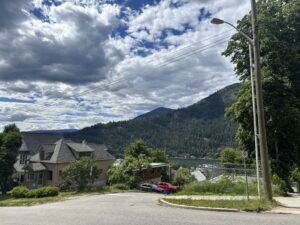
I live near Silica Street and Hall Street in Nelson, British Columbia. When I stand near this intersection, I see heritage houses, maple trees, steep streets, Kootenay Lake, and forested mountains. The photo I chose shows this clearly: an ordinary residential street, but also a lake town built into a mountain landscape. I moved here three years ago in winter. My first impression was that the snow, hills, and old houses made the neighbourhood look like a wonderland. Nelson also feels different from a large city like Vancouver. People here often talk about “Kootenay time”: slow down, take your time, enjoy your coffee first.
I am still learning the deeper history of this place. The City of Nelson acknowledges that it sits within the unceded traditional territories of the Sinixt, Syilx, and Ktunaxa peoples.[1] Before Nelson became a mining town, this was not empty wilderness. The lake, forests, rivers, fish, animals, berries, and mountain routes were part of Indigenous homelands and seasonal life. I do not know this history as well as I should, but this exercise helped me see that my neighbourhood belongs to a much older environmental and cultural landscape.
The natural environment is still the first thing I notice here. Nelson is an urban neighbourhood, but it is surrounded by forests, lake water, wildlife, snow, and mountains. Evening walks remind me that Nelson is not separate from wildlife. Sometimes I have to turn around because a mother bear and her cubs are nearby, or because a skunk has given enough warning that it is better to choose another route. Deer also moves through town, and in the wider region people often talk about cougars, wolves, and black bears. Wildlife is not only outside Nelson. It moves through the neighbourhood.
The seasons also change the town sharply. Winter snow makes the hills quiet and bright. Late spring brings flowers. Fall turns the maple leaves red, yellow, and orange. Summer now also brings wildfire smoke, which has become one of the clearest reminders that this landscape is fragile. Nelson has seen two consecutive winters with little snowfall, and summer wildfires now feel like a regular part of life.
Nelson’s modern history began with mining. In 1886, copper-silver deposits were discovered on Toad Mountain, leading to the development of the Silver King mine.[2] Mining transformed the surrounding environment. It required timber, roads, labour, ore transport, smelting, and new settlement. The City of Nelson notes that by 1894 the town was served by two railways, and in 1895 an aerial tramway carried ore from the Silver King mine to a smelter site in Nelson.[3] In other words, the town did not simply grow beside nature. It grew by extracting from the mountain landscape.
The older buildings downtown help me understand this history. Nelson has many heritage houses and commercial buildings that make the town feel connected to its mining and railway past. These buildings are beautiful, but they also show how resource extraction created wealth, settlement, and urban form. The houses and streets near Silica and Hall are part of that story.
Kootenay Lake is another major part of my environmental history here. I go to Lakeside Park two or three times a week, often to play soccer. I see the lake as recreation, scenery, wildlife habitat, and transportation history all at once. A peer-reviewed article by T. G. Northcote argues that human activity affected Kootenay Lake’s salmonid community through fishing, fish-culture activities, species introductions, and changes to spawning streams.[4] This matters because the lake is not just a beautiful background. It is an altered ecosystem with a long history of use and management.
Water also affects the neighbourhood directly. Nelson is built on a slope, so snowmelt and heavy rain move downhill through streets, drains, yards, and old creek systems. I have noticed that snowmelt affects drainage around many uphill houses. Kootenay Lake itself is also managed and constrained by larger water systems. The International Joint Commission notes that Kootenay Lake is regulated by Corra Linn Dam and influenced by Grohman Narrows, a natural constriction downstream.[5] This helps explain why flooding and high-water events matter in Nelson, especially along the waterfront.
Invasive species are another part of Nelson’s environmental history. I want to focus on Eurasian watermilfoil because it connects directly to Kootenay Lake. A regional aquatic invasive species report states that Eurasian watermilfoil and curlyleaf pondweed are present throughout Kootenay Lake and the Columbia and Kootenay Rivers.[6] These species spread through human activity, especially boating and recreation. This is a modern form of ecological change: people move across the landscape, and plants and animals move with them.
Today, I also see stewardship actions around Nelson. There are recycling programs, composting efforts, bike paths, community gardens, lake protection signs, wildfire prevention notices, and local food culture. Nelson’s climate plan, Nelson Next, focuses on both reducing emissions and preparing for future climate changes.[7] The City is also developing a residential pre-treated organics diversion program to keep food scraps out of regular garbage.[8] Wildfire prevention is especially important because Nelson is surrounded by forest. The City’s wildfire mitigation work includes pruning trees, removing combustible materials, prescribed burns, and FireSmart education.[9] A peer-reviewed study on British Columbia’s 2017 wildfire season found that human-caused climate change greatly increased wildfire risk factors and the area burned.[10] That helps explain why wildfire smoke now feels like part of summer life.
Looking at Silica and Hall through an environmental history lens changes how I see my neighbourhood. Before, I mostly noticed the view: the lake, trees, mountains, old houses, and changing seasons. Now I see that town life and nature are connected. Nelson’s beauty comes from the land, but the land has also been reshaped by Indigenous use, mining, railways, lake management, invasive species, urban development, and climate change. Living here reminds me that environmental history is not only about the past. It is also about how people care for the place they live now.
Bibliography
City of Nelson. “A Brief History of Nelson.” Accessed June 23, 2026. https://www.nelson.ca/491/A-Brief-History-of-Nelson.
City of Nelson. “Climate Action.” Accessed June 23, 2026. https://www.nelson.ca/804/Nelson-Next-Climate-Plan.
City of Nelson. “Climate & Energy.” Accessed June 23, 2026. https://www.nelson.ca/930/Climate-Energy.
City of Nelson. “Wildfire Mitigation.” Accessed June 23, 2026. https://www.nelson.ca/1010/Wildfire-Mitigation.
City of Nelson. “Accessibility.” Let’s Talk Nelson. Accessed June 23, 2026. https://letstalk.nelson.ca/accessibility.
International Joint Commission. Kootenay Lake Information Paper. January 31, 2022. https://ijc.org/sites/default/files/Kootenay-Lake-Information-Paper.pdf.
Kirchmeier-Young, Megan C., Nathan P. Gillett, Faron S. Anslow, Andrew J. Cannon, and Xuebin Zhang. “Attribution of the Influence of Human-Induced Climate Change on an Extreme Fire Season.” Earth’s Future 7, no. 1 (2019): 2–10. https://doi.org/10.1029/2018EF001050.
Northcote, T. G. “Kootenay Lake: Man’s Effects on the Salmonid Community.” Journal of the Fisheries Research Board of Canada 29, no. 6 (1972): 861–65. https://doi.org/10.1139/f72-129.
Vogel, J., K. Fraser, and C. Harkness. Protecting Our Waters from Aquatic Invasive Species: Phase II. Fish and Wildlife Compensation Program, January 2016. https://a100.gov.bc.ca/pub/acat/public/viewReport.do?reportId=50901.
[1] City of Nelson, “Accessibility,” Let’s Talk Nelson, accessed June 23, 2026, https://letstalk.nelson.ca/accessibility.
[2] City of Nelson, “A Brief History of Nelson,” accessed June 23, 2026, https://www.nelson.ca/491/A-Brief-History-of-Nelson.
[3] City of Nelson, “A Brief History of Nelson.”
[4] T. G. Northcote, “Kootenay Lake: Man’s Effects on the Salmonid Community,” Journal of the Fisheries Research Board of Canada 29, no. 6 (1972): 861–865, https://doi.org/10.1139/f72-129.
[5] International Joint Commission, Kootenay Lake Information Paper, January 31, 2022, https://ijc.org/sites/default/files/Kootenay-Lake-Information-Paper.pdf.
[6] J. Vogel, K. Fraser, and C. Harkness, Protecting Our Waters from Aquatic Invasive Species: Phase II, Fish and Wildlife Compensation Program, January 2016, https://a100.gov.bc.ca/pub/acat/public/viewReport.do?reportId=50901.
[7]City of Nelson, “Climate Action,” accessed June 23, 2026, https://www.nelson.ca/804/Nelson-Next-Climate-Plan.
[8]City of Nelson, “Climate & Energy,” accessed June 23, 2026, https://www.nelson.ca/930/Climate-Energy.
[9]City of Nelson, “Wildfire Mitigation,” accessed June 23, 2026, https://www.nelson.ca/1010/Wildfire-Mitigation.
[10] Megan C. Kirchmeier-Young et al., “Attribution of the Influence of Human-Induced Climate Change on an Extreme Fire Season,” Earth’s Future 7, no. 1 (2019): 2–10, https://doi.org/10.1029/2018EF001050.