Lafarge Lake in Coquitlam
April 15, 2026 By: An Chen
Location: https://maps.app.goo.gl/CA8N6d1pEqmhEfw99
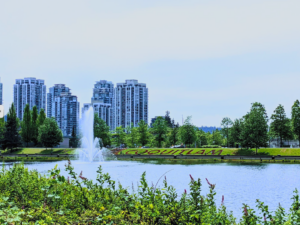
Lafarge Lake is a man-made lake in central Coquitlam’s Town Centre Park. The story of this land is one of dramatic change: from Indigenous stewardship, to industrial extraction, to the urban oasis we see today. Over 10,000 years, the area now called Coquitlam was the homeland of the Kwikwetlem people. Archaeological sites at Coquitlam Lake are among the oldest in the Lower Mainland, showing First Peoples arrived more than 10,000 years ago. The Kwikwetlem moved seasonally across the land, following plant and animal cycles. They got all their food, medicine, and materials for tools and shelter from the natural world around them. The name “Kwikwetlem” means “Red Fish Up the River,” referring to a spring sockeye salmon run that once flourished in the Coquitlam River and Coquitlam Lake. The Kwikwetlem were master sturgeon and salmon fishers, skilled canoe builders, and renowned spirit dancers. The land, the water, and the salmon were central to every part of their lives.
In 1889, Coquitlam was officially incorporated, and soon after, Frank Ross and James McLaren opened Fraser Mills, a huge lumber mill on the north bank of the Fraser River. Logging took off, and forests that had stood for centuries were cut down to feed the mill. In 1899, Chief Johnnie of the Kwikwetlem Nation wrote to the federal government, begging them not to dam the Coquitlam River. He explained that his people’s survival depended directly on the salmon. His letter was ignored. The dam went up, and the sockeye salmon run collapsed almost to extinction. The name “Kwikwetlem” became a memory of what was lost.
Fast forward to the mid-20th century. The land where Lafarge Lake now sits was a gravel quarry operated by the Lafarge lake. For years, heavy machinery dug into the earth, pulling out gravel and leaving behind a big, ugly pit. Locals called it “Glen Pit”. It wasn’t a lake—it was an industrial scar on the landscape.
In the 1970s, Don Cunnings, Coquitlam’s Recreation Director, and City Planner Don Buchanan were invited to lunch by the CEO of Lafarge. The company wanted permission to expand its quarry below street level, but Cunnings knew city council would say no. Then, as the waiter refilled his water glass, Cunnings had a flash of inspiration: turn the quarry into a lake when the mining was done. He told the CEO, “A park without water is like a living room without a fireplace,” and somehow, it worked. The company agreed to donate the land.
Lafarge Canada formally donated the former quarry site to the City of Coquitlam in the mid-1980s. Natural springs gradually filled the excavated pit with water. Town Centre Park officially opened in May 1989, and Lafarge Lake Park was inaugurated in 1991. Today, the lake is stocked with rainbow trout in the spring and fall, and it’s home to waterfowl, beavers, common carp, brown bullhead, and bluegill.
The lake is man-made, not natural. The fountain and lights installed in 2014 drove away bats and many water bird species, including wood ducks and hooded mergansers, and the original salmon that gave the Kwikwetlem people their name? They never came back. The lake is now a community hub and a place where people walk, fish, and gather for the annual Lights at Lafarge festival. It’s a small piece of reconciliation, too. It is also a reminder of what was lost and what we might still protect.