Parry Sound, Ontario
August 28, 2026 By: Matthew Lynch
Location: 27 Prospect Street, Parry Sound, ON P2A 2B5
Environmental History of Parry Sound
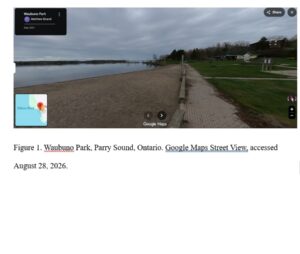
For the last several years, I have lived in the beautiful, scenic region of Parry Sound, Ontario. This region, which is situated on the Canadian Shield, has a fascinating ecological history dating back to pre-settlement times. In this essay, we will examine the environmental past of my beautiful home. Although the photo I’ve attached shows beautiful, pristine wilderness, the current state of the area is the result of centuries of interaction between humans and their environment. From Indigenous use of the land to the settlement of the Europeans to use of the land for resources, and later infrastructure development, all have contributed to the stunning landscape that can be seen today.
The attached photograph, from Google Maps, was taken near my home, and shows both the natural and artificial areas of Parry Sound. One can admire the beautiful waterfront of Georgian Bay, and also the sand and rocks that line the shore. In addition, it shows trees, concrete structures, benches, and tables as well as a lifeguard shack.
Parry Sound, as mentioned previously, is located at the edge of the Canadian Shield, which is both the oldest and largest geologic region in Canada. It consists of rocky landscapes, thin layers of soil, and lakes and bogs. Its underlying rocks, which consist of both granite and volcanic rock, are over a billion years old. They also contain another particular type of rock called gneiss, which is deeply associated with this area. It is made of alternating light and dark bands and formed by pressure deep under the ground. In Parry Sound, the gneiss is actually a former mountain range, of similar size to the Himalayas, which has since eroded1.
Roughly 14,000 years ago, the town rested under a layer of ice nearly a kilometer thick. The rocks and sand under it both scraped and polished the bedrock, which created the beautifully polished rocks that can be seen today. The same glaciers also removed much of the soil, which is why so much rock is exposed. In addition, the famous Thirty Thousand Islands were also created by the ice. Specifically, the ridges and valleys came to be when gneiss eroded at different rates, which produced ridges and valleys, which, in turn, became islands once they merged with the bay2.
The Parry Sound area is part of the Precambrian Shield, a large area consisting of rocky hills and knobs, separated by depressions. The soil is not spread evenly, however: Instead, some areas consist of uncovered bedrock, and others of deposits of rocky glacial material. The deeper sand and silt deposits were once glacial meltwater and lakes3.
As beautiful as this process has made the area, it has not been without its downsides. The thin soil and rocky terrain are not conducive to agriculture. Therefore, growing food here is not an easy task4.
This latter point is crucial to understanding the environmental history of the regions. The town’s own website states that the lives of many early settlers were greatly complicated by the thin soil and abundant rock, which made establishing agricultural settlements a challenge5.
The Parry Sound region sits on the ancestral territory of the Anishinabek, who, while agriculture may have been a challenge, used the region for hunting, as medicine areas, and for gathering6.
In addition, the Seguin River provided the First Nations with a means of transportation, in addition to providing wildlife resources, such as deer, bear, beavers, and walleye, which were traditional food sources for the First Nations people7.
Today, the area is rife with reptiles, birds, and mammals8, including bears9.
The first Europeans arrived in the area in the early 1600s. The French explorer Samuel de Champlain arrived in central Ontario in 1615. France was initially interested the fur trade, which relied largely upon the networks of the First Nations peoples10. The Wendat people grew in importance as intermediaries to move furs from the Great Lakes to French markets11.
European settlement in the area, though, began in 1857, when a sawmill was established at the mouth of the Seguin River. The region’s timber provided industry, and transportation networks sprung up around it12. The river itself was used to bring the wood from place to place13.
Pine logging arrived later in the area than in some other places, as the region’s rivers flowed to Georgian Bay, away from the major timber markets of the early 1800s. That changed, however, in 1860. Around that time, settlement began in the American Midwest, which meant that lumber was in demand. At the same time, American timber supply was running out, leading to the area being looked upon as a valid source of it. Due to this, the government auctioned timber limits and sawmills were built at the mouths of local rivers14.
In 1887, the region was incorporated, and railway development came soon thereafter15.
The town also contains a number of invasive species. For example, invasive Phragmites have been identified as a hazard due to their ability to displace natural flora and alter the ecosystem16.
In addition, while zebra mussels could be seen as a threat, the low concentration of calcium in the region’s waters prevents them from reproducing in abundance, making their effects somewhat less significant17. These species represent more recent ecological change, as organisms introduced by human activities can alter the ecosystem.
The town has also taken part in a number of stewardship actions. For example, the town has a stormwater containment system consisting of culverts, ditches, and gutters to redirect heavy precipitation and prevent flooding18. In addition, the town’s current Pump Station 2 project involves building 700 m of new infrastructure to reduce flooding19.
This shows that even in the modern day, the town continues to attempt to contain environmental hazards.
In summary, Parry Sound and the larger Georgian Bay area are beautiful places to live, and their economies, histories, and current landscape were shaped by a variety of environmental factors. It was fascinating to learn about my home’s history, and it will be equally riveting to see how the environment continues to shape this area in the years to come.
Figure 1. Waubuno Park, Parry Sound, Ontario. Google Maps Street View, accessed August 28, 2026.
- Ontario Geological Survey, Parry Sound: Canadian Shield and Glacier-Sculpted Gneiss in Cottage Country, GeoTour (Ontario Ministry of Northern Development, Mines, Natural Resources and Forestry, 2015), 1–2, https://files.ontario.ca/ndmnrf-geotours-parry-sound-en-2021-12-13.pdf.
- Ontario Geological Survey, Parry Sound, 3–5.
- D. W. Hoffman, N. R. Richards, and F. F. Morwick, Soil Survey of Parry Sound District, Report No. 31 of the Ontario Soil Survey (Guelph: Research Branch, Canada Department of Agriculture and Ontario Agricultural College, 1964), https://sis.agr.gc.ca/cansis/publications/surveys/on/on31/on31_report.pdf.
- Hoffman, Richards, and Morwick, Soil Survey of Parry Sound District, 15–16.
- Parry Sound Downtown Business Association, “About,” Downtown Parry Sound, accessed August 28, 2026, https://downtownparrysound.ca/about/.
- Parry Sound Downtown Business Association, “About.”
- Ontario Ministry of Natural Resources, Seguin River Conservation Reserve: Statement of Conservation Interest (Parry Sound District, March 2003), https://www.ontario.ca/page/seguin-river-conservation-reserve-management-statement.
- Sioux Lookout Meno Ya Win Health Centre, “Miichim,” accessed August 28, 2026, https://slmhc.on.ca/departments-and-services/tradition al-program/miichim/.
- Town of Parry Sound, “Wildlife,” accessed August 28, 2026, https://www.parrysound.ca/town-services/animal-services/wildlife/.
- Ontario Heritage Trust, “Champlain and Huronia, 1615,” Samuel de Champlain, accessed August 28, 2026, https://www.heritagetrust.on.ca/fr/pages/our-stories/exhibits/samuel-de-champlain/history/champlain-and-huronia-1615.
- Canadian Museum of History, “Fur Trade,” Virtual Museum of New France, accessed August 28, 2026, https://www.historymuseum.ca/virtual-museum-of-new-france/economic-activities/fur-trade/.
- Visit Parry Sound, “History of Parry Sound,” accessed August 28, 2026, https://visitparrysound.com/history.php.
- Ontario Ministry of Natural Resources, Seguin River Conservation Reserve.
- John MacFie, “Dam It! So That’s How Loggers Drove Those Creeks,” Forestory 1, no. 2 (Fall 2010), Forest History Society of Ontario, https://www.ontarioforesthistory.ca/media/forestory/fhso_journ_vol_01_iss_2_fall_2010.pdf.
- Parry Sound Downtown Business Association, “About.”
- Georgian Bay Association, “Invasive Species,” accessed August 28, 2026, https://georgianbay.ca/lands-forests/invasive-species/.
- E. Todd Howell, “The Aquatic Environment of Parry Sound, a Deep-Water Embayment Complex of Georgian Bay Protected from Dreissena,” Journal of Great Lakes Research 49, no. 3 (2023): 651–71, https://doi.org/10.1016/j.jglr.2023.03.015.
- Town of Parry Sound, “Stormwater Services,” accessed August 28, 2026, https://www.parrysound.ca/town-services/water-and-environmental/stormwater-services/.
- Town of Parry Sound, “New Pump Station Project Breaks Ground, Paving the Way for More Housing and Economic Development,” July 9, 2025, https://www.parrysound.ca/news/posts/new-pump-station-project-breaks-ground-paving-the-way-for-more-housing-and-economic-development/.
Bibliography
Canadian Museum of History. “Fur Trade.” Virtual Museum of New France. Accessed August 28, 2026.
https://www.historymuseum.ca/virtual-museum-of-new-france/economic-activities/fur-trade/
Georgian Bay Association. “Invasive Species.” Georgian Bay Association. Accessed August 28, 2026.
https://georgianbay.ca/lands-forests/invasive-species/
Google. “Waubuno Park, Parry Sound, Ontario.” Google Maps. Street View. Accessed August 28, 2026.
https://www.google.com/maps/place/Waubuno+Beach/
Hoffman, D. W., N. R. Richards, and F. F. Morwick. Soil Survey of Parry Sound District. Report No. 31 of the Ontario Soil Survey. Guelph: Research Branch, Canada Department of Agriculture and Ontario Agricultural College, 1964.
https://sis.agr.gc.ca/cansis/publications/surveys/on/on31/on31_report.pdf
Howell, E. Todd. “The Aquatic Environment of Parry Sound, a Deep-Water Embayment Complex of Georgian Bay Protected from Dreissena.” Journal of Great Lakes Research 49, no. 3 (2023): 651–71.
https://doi.org/10.1016/j.jglr.2023.03.015
MacFie, John. “Dam It! So That’s How Loggers Drove Those Creeks.” Forestory 1, no. 2 (Fall 2010). Forest History Society of Ontario.
https://www.ontarioforesthistory.ca/media/forestory/fhso_journ_vol_01_iss_2_fall_2010.pdf
Ontario Geological Survey. Parry Sound: Canadian Shield and Glacier-Sculpted Gneiss in Cottage Country. GeoTour. Ontario Ministry of Northern Development, Mines, Natural Resources and Forestry, 2015.
https://files.ontario.ca/ndmnrf-geotours-parry-sound-en-2021-12-13.pdf
Ontario Heritage Trust. “Champlain and Huronia, 1615.” Samuel de Champlain. Accessed August 28, 2026.
https://www.heritagetrust.on.ca/fr/pages/our-stories/exhibits/samuel-de-champlain/history/champlain-and-huronia-1615
Ontario Ministry of Natural Resources. Seguin River Conservation Reserve: Statement of Conservation Interest. Parry Sound District, March 2003.
https://www.ontario.ca/page/seguin-river-conservation-reserve-management-statement
Parry Sound Downtown Business Association. “About.” Downtown Parry Sound. Accessed August 28, 2026.
https://downtownparrysound.ca/about/
Sioux Lookout Meno Ya Win Health Centre. “Miichim.” Accessed August 28, 2026.
https://slmhc.on.ca/departments-and-services/traditional-program/miichim/
Town of Parry Sound. “New Pump Station Project Breaks Ground, Paving the Way for More Housing and Economic Development.” July 9, 2025.
https://www.parrysound.ca/news/posts/new-pump-station-project-breaks-ground-paving-the-way-for-more-housing-and-economic-development/
Town of Parry Sound. “Stormwater Services.” Accessed August 28, 2026.
https://www.parrysound.ca/town-services/water-and-environmental/stormwater-services/
Town of Parry Sound. “Wildlife.” Accessed August 28, 2026.
https://www.parrysound.ca/town-services/animal-services/wildlife/
Visit Parry Sound. “History of Parry Sound.” Accessed August 28, 2026.
https://visitparrysound.com/history.php