Salmon Arm , BC
May 13, 2026 By: Kayla Wassen
Location: 1370 15 ave SE
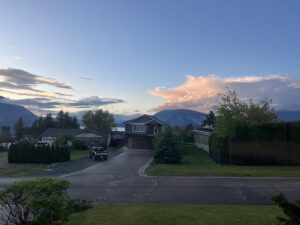
I live on the unceded traditional territory of the Secwépemc people, in the area now known as Salmon Arm, British Columbia. Living in this region has made me increasingly aware that the landscapes surrounding me carry histories far older than the city itself. The mountains, waterways, forests, and grasslands that shape the Shuswap region have supported human and ecological communities for thousands of years, long before modern development transformed the area.
I live in the Hillcrest neighbourhood, an area that has continued to expand rapidly over the last several years. New housing developments are constantly appearing, and patches of forest and farmland are gradually being cleared to make room for more homes. From my house, I can see Mt. Ida, Mt. Bastion, Badger Mountain, and Shuswap Lake. These landscapes are part of what drew my family to the area when we moved here four years ago. Although Hillcrest is suburban and growing quickly, the mountains and lake create a constant reminder that the natural environment is still deeply connected to everyday life here.
Long before settlers arrived in the Shuswap region, this area was part of Secwepemcúl’ecw, the traditional territory of the Secwépemc people, who have lived in the region for more than 10,000 years (https://shuswaptrails.com/points/). The Secwépemc relied on interconnected systems of lakes, rivers, forests, and grasslands through seasonal movement, fishing, hunting, and gathering. Salmon were especially important to the region both culturally and environmentally, sustaining not only human communities but also surrounding ecosystems. Even the name “Salmon Arm” reflects the importance of salmon within the area’s waterways. Salmon populations historically played a major role in sustaining ecosystems and communities throughout the region (https://www.thompsonshuswapsalmon.org/about-us/where-we-work.htm).
Colonization dramatically altered both Indigenous communities and the surrounding environment. Before European contact, the Secwépemc population is estimated to have been approximately 25,000 people before being drastically reduced by the 1862 smallpox epidemic (https://shuswaptrails.com/points/). European settlement transformed the landscape through forestry, agriculture, railways, and eventually highways. Forests were cleared for farmland and housing, wetlands were altered, and transportation routes changed wildlife movement and land use patterns. Agriculture and transportation development played a major role in shaping the community during the late nineteenth and early twentieth centuries (https://www.salmonarmmuseum.org/onlinearchivalresources.htm).
Many of these historical changes can still be seen in neighbourhoods like Hillcrest today. Highway 1 runs directly through Salmon Arm, connecting the community to tourism and economic growth while also increasing traffic, pollution, and development pressure. Tourism depends heavily on the natural beauty of the region. People are drawn to Shuswap Lake, nearby hiking trails, mountains, and wildlife, but increased recreation and population growth also place stress on these ecosystems. While Hillcrest still contains some farmland, forest patches, and older trees, many of these spaces are gradually disappearing as new subdivisions are built. Today, Hillcrest reflects many of the landscaping values common in suburban neighbourhoods across North America. Most homes are surrounded by green lawns, irrigation systems, ornamental plants, and carefully maintained outdoor spaces. When my family bought our home four years ago, the yard was what many people would consider “perfect.” It was a completely green lawn with underground sprinklers and very few trees or naturalized areas. It felt sterile, but we also saw it as a blank canvas. Shortly after moving in, a lawn care company used by the previous owners came to spray the yard for weeds. We returned home to a note on the door letting us know that children and pets should stay off the lawn for twenty-four hours. With two small children and a dog, it felt like a reminder that the “suburban ideal” of a perfectly maintained lawn is not always environmentally friendly or supportive of a healthy ecosystem.
Over the last four years, my family has slowly started changing the space around us by planting trees and shrubs, building vegetable gardens, composting food waste, and adding wildflowers and other plants that support pollinators and birds. “Rewilding” our front yard has become a personal goal for me, although it is still not something I see happening widely throughout the neighbourhood. In my opinion, suburban spaces have a great deal of potential for environmental stewardship. Even relatively small yards can provide food and shelter for birds, pollinators, and other wildlife when planted intentionally (https://www.audubon.org/content/why-native-plants-matter). In growing communities like Salmon Arm, small changes such as reducing lawn space or planting native species can still have meaningful environmental impacts.
One of the most rewarding outcomes of these changes has been the increase in wildlife visiting our yard, especially birds. We now regularly see California quails, finches, chickadees, and a pair of mallard ducks my children have affectionately named Lenny and Clover. Their presence has encouraged all of us to learn more about what birds and wildlife need to thrive in suburban spaces, and our “to-plant” list seems to have no end. We are currently planning a small wildlife pond to attract frogs and insects as well.
Salmon Arm is already known for its bird populations and wetland ecosystems surrounding Salmon Arm Bay. Organizations such as SABNES work to protect local bird habitat and wetlands through stewardship and conservation efforts (https://www.sabnes.org/). The foreshore pathways and Raven Trail area also allow residents to interact directly with local ecosystems and wildlife.
Wildfire has also become an unavoidable part of life in the BC Interior. During severe wildfire seasons, smoke can settle into the valley for days or weeks at a time. As development continues to spread into forested areas around Hillcrest and the surrounding mountains, the balance between growth and environmental sustainability becomes increasingly fragile. Invasive species are also an ongoing issue throughout the Shuswap region, particularly in disturbed areas and suburban landscapes (https://columbiashuswapinvasives.org/). Native plants, drought-resistant landscaping, and reduced lawn irrigation may become increasingly important as communities adapt to hotter and drier conditions.
The land around present-day Salmon Arm has shifted from Indigenous stewardship, to resource extraction and settlement, to modern suburban development. In a place like Hillcrest, these changes still feel very visible as forests continue to disappear and development expands further into natural spaces. Wildfire smoke has also become an increasingly common part of summer in the Interior, making the relationship between people and the environment feel impossible to ignore. While one yard cannot change an entire community, I think small choices around landscaping and stewardship still matter, especially when they help create habitat and strengthen people’s connection to the natural world around them.
References